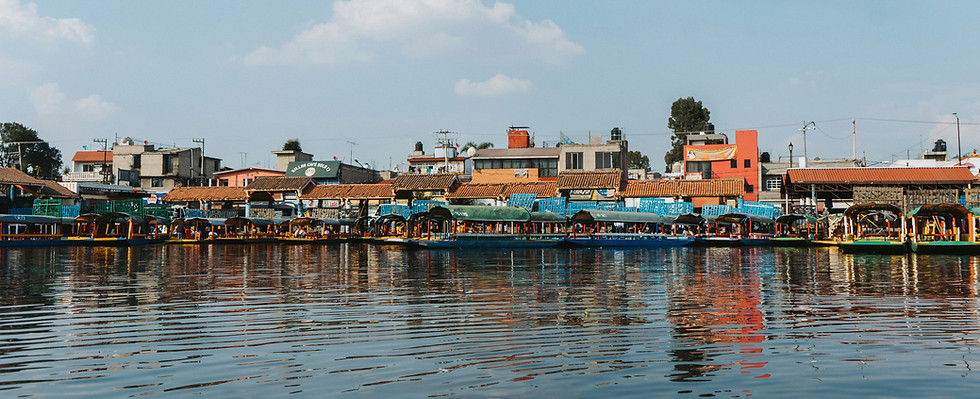
Xochimilco is an intricate network of natural canals and artificial islands (chinampas) spanning approximately 170 km² in southern Mexico City. The canals are the remnants of what was once an extensive lake and canal system that connected most of the settlements in the Valle de México (Valley of Mexico). These canals, along with the artificial islands known as chinampas, attract tourists and local residents who ride on colourful gondola-like boats called trajineras.
Xochimilco's system of waterways was once the main means of transportation, especially for goods, particularly during the pre-Hispanic period. Today, the canals are fed by freshwater springs, which are artificially supplemented with treated water. This is because water tables continue to decline, while urban expansion and the filling in of canals persist, threatening the survival of the last remaining waterways.
Xochimilco is home to a large number of species, including migratory birds, amphibians, and reptiles. Perhaps the most representative animal found in these waters is the axolotl (Ambystoma mexicanum), a salamander that reaches sexual maturity while retaining its larval form, a phenomenon unique among amphibians. Although primarily aquatic, axolotls have a limited ability to breathe air. They can also regenerate limbs and other body parts, making them the focus of numerous scientific studies. As of 2014, only around 36 axolotls per km² were estimated to remain in the canals of Xochimilco. Updated figures are expected following the 2024–25 axolotl census conducted by UNAM, with results anticipated to provide the most current assessment of the species’ wild population.
Most of the threats to the species stem from habitat loss and pollution, but the introduction of non-native fish such as tilapia has also had devastating effects on their population.
In 2023, Mexico was announced as one of the hosts of the FIFA World Cup, alongside Canada and the United States. To welcome football-related visitors to Mexico City, the capital's government launched a campaign to decorate walls, bridges, and lamp posts with images of ajolotes, predominantly in purple and lilac colours. Authorities described these changes as a way to "beautify" the city in the lead-up to the international event. However, numerous collectives and organisations strongly criticised the strategy, describing it as political propaganda and accusing the government of neglecting living ajolotes, whose conservation efforts have been underfunded for decades.
Xochimilco es una compleja red de canales naturales e islas artificiales (chinampas), que cubre unos 170 km² al sur de la Ciudad de México. Esta red es lo que queda de un enorme sistema de lagos y canales que solía conectar la mayoría de los asentamientos en el Valle de México. Tanto los canales como las chinampas atraen a turistas y locales que pasean en coloridas embarcaciones similares a góndolas conocidas como trajineras.
Los canales de Xochimilco fueron alguna vez la principal forma de transporte, especialmente para mover mercancías durante la época prehispánica. Hoy en día, el nivel de agua en los canales es mantenido no sólo por manantiales de agua dulce sino por agua tratada debido a la excesiva extracción de este líquido. Asimismo, el crecimiento urbano y el relleno de canales continúan amenazando su existencia.
Xochimilco alberga una gran cantidad de especies, incluyendo aves migratorias, anfibios y reptiles. Sin duda, el animal más representativo de estas aguas es el ajolote (Ambystoma mexicanum), una salamandra que alcanza la madurez sexual mientras conserva su forma larval, un fenómeno único entre los anfibios. Aunque es principalmente acuático, el ajolote tiene una capacidad limitada para respirar aire. También puede regenerar sus extremidades, lo que lo ha convertido en el centro de numerosos estudios científicos. Hasta 2014, se sabía que existían alrededor de 36 ajolotes por km² dentro de los canales, mientras que datos más actualizados provendrán del censo realizado por la UNAM entre 2024 y 2025.
La mayoría de las amenazas para la especie provienen de la pérdida de hábitat y la contaminación, pero la introducción de peces no nativos como la tilapia también ha tenido efectos devastadores en su población.
En 2023, se anunció que México sería uno de los anfitriones de la Copa Mundial de la FIFA, junto con Canadá y Estados Unidos. Para recibir a los visitantes en la Ciudad de México, el gobierno de la capital lanzó una campaña para decorar paredes, puentes y postes con imágenes de ajolotes, predominantemente en colores púrpura y lila. Las autoridades describieron estos cambios como una forma de “embellecer” la ciudad para el evento internacional. Sin embargo, numerosos colectivos y organizaciones criticaron fuertemente la estrategia, describiéndola como propaganda política y acusando al gobierno de descuidar a los verdaderos ajolotes, cuya conservación se ha visto desatendida durante décadas.


Photo by Tommy Bond


Photo by Vanguardia.mx
Photo by Brenda Huescas

Photo by Roger Ce
Photo by Iván Cortéz